
Greeting campaign: Say Hello to
the People Around You
Join Ciao Table's Say Hello Campaign.Let's exchange greetings with people near us in public places: table neighbours in a restorant, those by our umbrella on the beach, fellow bench-sitters, or people nearby in cinemas, theatres, shops, or public offices. Why?
SAYING HELLO IS... HEALTHY
Scientific studies show that a greeting can be good for you as well as for the person who receives it.
The scientific literature has long recognized social connections as a fundamental protective factor for psychophysical health.
Indeed, it has been scientifically proven that a lack of social connections increases the risk of premature mortality (estimated to be between 33% and 50%, depending on the study), and increases the likelihood of anxiety, depression, and the development of dementia. Furthermore, social connections enhance the effectiveness of the immune response.
For further information, see our Our Bibliography and in particular Holt-Lunstad, J. (2020). The double pandemic of social isolation and COVID-19: Cross-sector policy must address both. Health Affairs Forefront. Naito, R., McKee, M., Leong, D., Bangdiwala, S., Rangarajan, S., Islam, S., & Yusuf, S. (2023). Social isolation as a risk factor for all-cause mortality: Systematic review and meta-analysis of cohort studies. PLOS ONE, 18(1), e0280308.
Recent studies also show that even minimal social interactions with strangers contribute to subjective well-being::
Epley, N., Akalis, S., Waytz, A., & Cacioppo, J. T. (2008). Creating social connection through inferential reproduction: Loneliness and perceived agency in gadgets, gods, and greyhounds. Psychological science, 19(2), 114-120.
Good morning, G., Oztekin, H., Karabulut, D. H., & Salman-Engin, S. (2021). Minimal social interactions with strangers predict greater subjective well-being. Journal of Happiness Studies, 22).
Sandstrom, G. M., & Dunn, E. W. (2014). Social interactions and well-being: The surprising power of weak ties. Personality and Social Psychology Bulletin, 40(7), 910-922.
Sandstrom, G. M., & Boothby, E. J. (2021). Why do people avoid talking to strangers? A mini meta-analysis of predicted fears and actual experiences talking to a stranger. Self and identity, 20(1), 47-71.
Sandstrom, G. M., Boothby, E. J., & Cooney, G. (2022). Talking to strangers: A week-long intervention reduces psychological barriers to social connection. Journal of Experimental Social Psychology, 102, 104356.
Beyond contributing to subjective well-being,a greeting also acts as a facilitator of social exchange; it is clear that it makes starting a conversation more likely, at least when both parties are willing to engage in one.
Through surveys and observations, we have found that in cities, greeting people nearby is certainly not customary, but nor is it entirely unusual: our appeal aims to encourage a practice that is consistent with our culture.
This campaign pursues the goal that the two associations, Ciao Table's Say Hello Campaign and Psychology and Psychotherapy Research Society , have set for themselves since 2017: to promote, within the region, a culture that increasingly facilitates positive social exchanges.
The initiative is being realised as a continuation of scientific and socio-cultural projects previously undertaken to promote social exchange: scientific conferences, Social Research Prize, “Open Doors of cultural associations offering leisure activities”, Leisure advice etc.
In addition, through GILC, Global Initiative on Loneliness and Connection, of which we are partners, we were able to have exchange of experiences with other associations in different countries, like us, who are committed to promoting social connections.
In particular, we took advantage of the valuable advice of Pete Bombaci, founder/CEO of Genwell, Canada, and creator of Talk to a Stranger Week, which was an important source of inspiration for our initiative; Christian Langkamp, of Initiative GemEinsankeit, author of Practical Friendship; Risa Wilkerson, Executive DirectorHealthy Places by Design, United States.
Our cities will become even healthier and more welcoming.
Living in them will be even more pleasant, and visiting them even more enjoyable.
Here are some testimonials from our "greeting activists":
Eva:: Yesterday at the pizzeria with my husband, we engaged in the Ciao Table's Say Hello Campaign. That is, simply, when we sat down, we greeted the couple at the neighboring table. A long conversation followed… These are things that bring a bit of joy.
Marco: At the cinema, I now greet whoever sits next to me. Usually it doesn't go beyond a simple greeting. Still, it's nice.
Natasha: This morning, getting on the bus, I greeted the woman in front of me. She looked at me but didn't respond. Never mind — I wasn't upset about it, because greeting is the right thing to do.
Alexander: I generally tend to greet people, for example in doctors' waiting rooms, or the driver when I get on the bus. The other day I also greeted the other customers waiting in line at the bank counter: a woman asked me for some information and we chatted for a bit.
Local media on the “Ciao Table Say Hello to the person next to you Campaign”

Angelica Arbasini
Censorship,
SEIDISERA Magazine
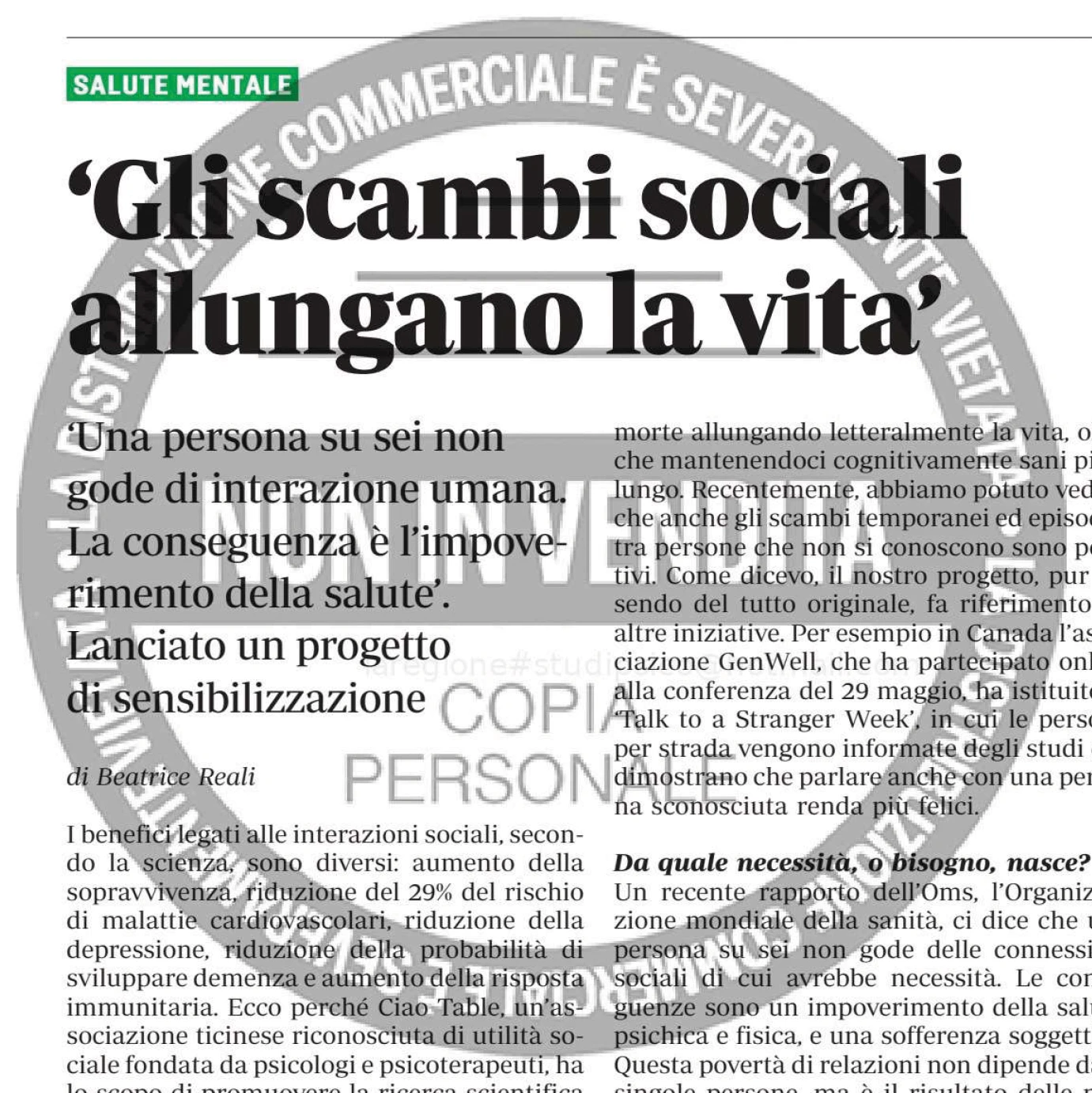
Beatrice Reali
«Social exchanges
extend life»

Isabella Visetti
«Prize for
social research»
Become a greeting activist too, and send us your testimonial at info@ciaotable.org
 English
  Italian
  French
  German